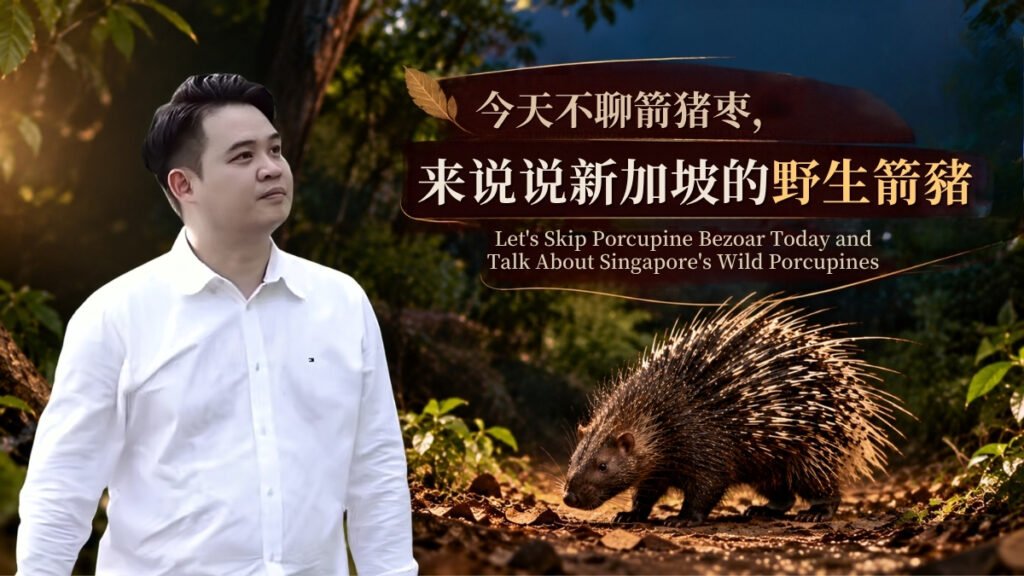
Let’s Skip Porcupine Bezoar Today
and Talk About Singapore’s Wild Porcupines
Singapore does have wild porcupines. After the 1970s, the Malayan porcupine was thought to have disappeared locally, until one was photographed again on Pulau Tekong in late 2005. Today its numbers remain small, and it is listed as Critically Endangered in Singapore.
When people in Singapore think of porcupines, the first thing that comes to mind is usually the forests of Indonesia or Malaysia. But Singapore has wild porcupines of its own. They hide in burrows during the day and only come out to look for food at night, so people rarely come across them.
I’ve often talked about where our porcupine bezoar (also known as porcupine date) comes from. This time, let’s talk about the porcupine itself.
What Do Singapore’s Wild Porcupines Look Like?
Singapore’s wild porcupine is the Malayan porcupine, scientific name Hystrix brachyura. It’s not a small animal: its body is about 60 to 70 cm long, not counting the tail.
The front half of its body is dark brown, almost black, while the back half is covered in long, stiff quills. These quills are actually modified hairs, and the longest ones on its back are banded black and white.
Some people think a porcupine is just a bigger hedgehog. In fact, porcupines are rodents, distant relatives of squirrels and rats, while hedgehogs belong to a different group of animals.
Porcupines can’t “shoot” their quills. When threatened, a porcupine rattles the quills on its tail to warn the other animal off. If it keeps coming closer, the porcupine may run backwards into it and use its quills to protect itself.
They usually rest in burrows during the day and come out after dark to feed on fallen fruit and on plant roots and stems, and they sometimes gnaw on bark.
Where Have They Been Seen in Singapore?
Long ago, porcupines were not uncommon in Singapore and were often seen in forests and plantations. As the forests shrank, and with hunting taking its toll, sightings became rare after the 1970s. For many years, people believed they had disappeared from Singapore.
In late 2005, a Malayan porcupine was photographed again on Pulau Tekong. Pulau Tekong is where many young men in Singapore do their National Service training, and the public can’t simply go there. Surprisingly, that is where the porcupine, missing for so many years, turned up again.
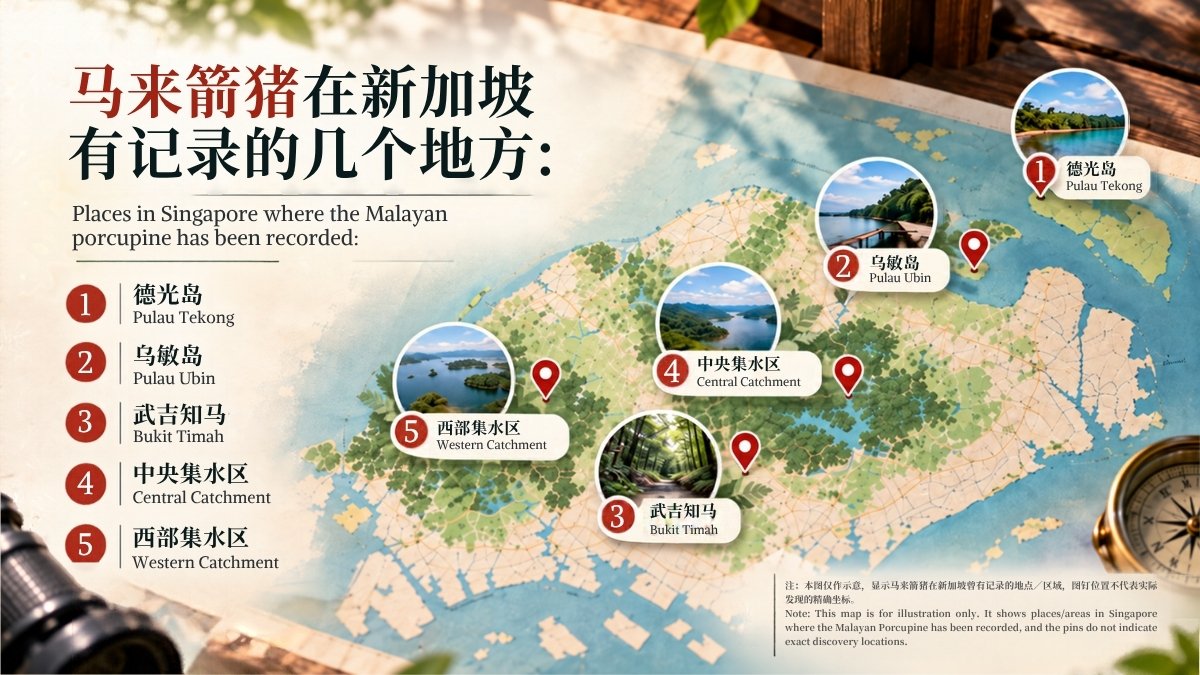
Later, as camera traps became more common in the wild, researchers recorded them on Pulau Ubin, in the Bukit Timah Nature Reserve and in the Central Catchment Nature Reserve. In 2012, the Western Catchment Area also had its first record.
Still, being photographed more often doesn’t mean there are more of them. According to the National Parks Board’s species records, the Malayan porcupine is still rare locally, and the third edition of The Singapore Red Data Book, published in 2024, still lists it as Critically Endangered.
Porcupines and Porcupine Bezoar
Porcupine bezoar is a stone that may form in a porcupine’s digestive tract. It is usually associated with undigested plant material that gradually builds up in the digestive tract and forms a hard mass.
But not every porcupine has a porcupine bezoar. Even when there is one, its size, shape and colour can differ.
Interestingly, porcupine bezoars from the Malayan porcupine (Hystrix brachyura) have indeed appeared in scientific studies. In other words, the wild porcupines in Singapore described above belong to a species in which research has found porcupine bezoars. That doesn’t mean, however, that a porcupine found in the wild in Singapore will necessarily have one.
So Where Does Our Porcupine Bezoar Come From?
Miracle Medicine’s porcupine bezoar comes from the forests of Indonesia and is obtained through humane extraction.
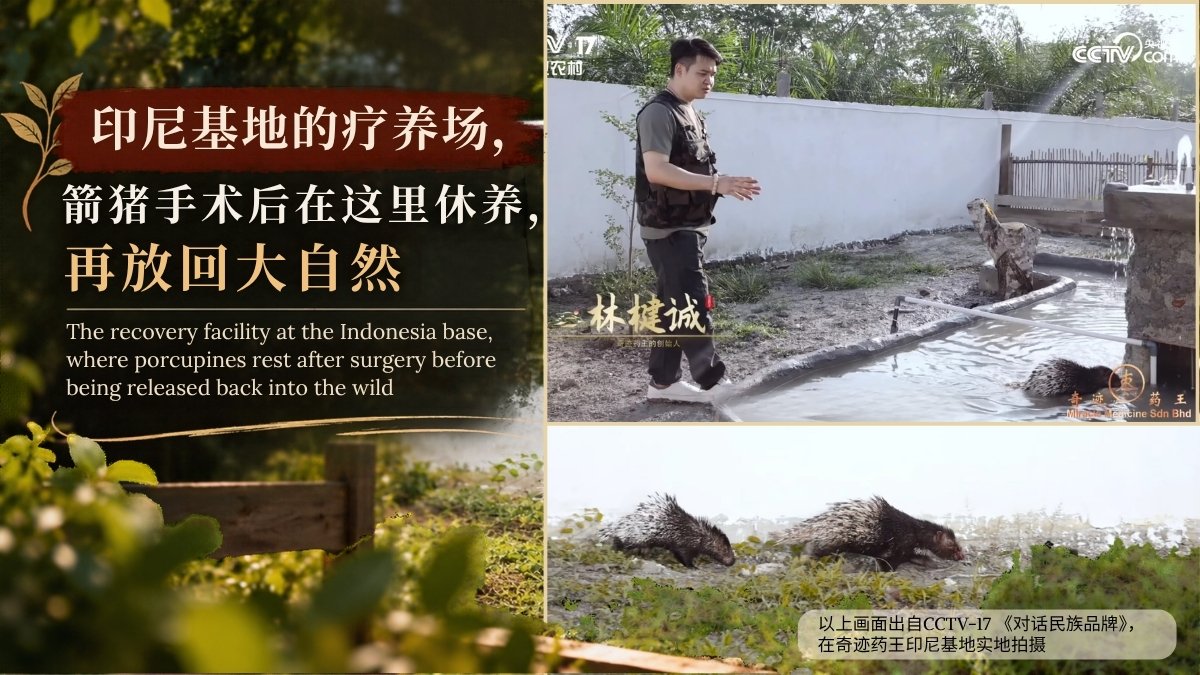
A team of nearly 300 deep-forest hunters and veterinarians catches the wild porcupines. Each porcupine is first scanned to confirm that there really is a bezoar inside; only then does a professional veterinarian remove it surgically. After the surgery, the porcupine rests at a dedicated recovery facility, and once its wound has healed, it is released back into the wild.
To be honest, surgery always carries some risk, which is exactly why we have a veterinary team and a recovery facility: to give every porcupine the best chance to recover before it returns to the hills.
What Should You Do If You Meet a Wild Porcupine in Singapore?
If you ever do come across a wild porcupine, keep your distance and watch from afar. Don’t approach, touch or feed it, and don’t use flash when taking photos, so you don’t frighten it.
If you find a porcupine that is injured or trapped, you can call the National Parks Board’s Animal Response Centre hotline at 1800-476-1600 for help.
Porcupine bezoar is a traditional natural health product, not a medicine, and it cannot be used to diagnose, treat or prevent any disease. This article is about Singapore’s wild porcupines and where porcupine bezoar comes from, and does not cover any health use.
Visit our Singapore store to see porcupine bezoar
If you would like to see the products, ask about where they come from and how they are obtained, and go through the certification documents and test reports, you’re welcome to book a visit.
miraclemedicine.com.my · The full humane extraction process Porcupine Date or Porcupine Bezoar? The Name Confusion Is Really About Trust →
miraclemedicine.com.sg · Dr. Lim on names and what to verify Where to Buy Porcupine Bezoar in Singapore: How In-Store Differs From Online →
miraclemedicine.com.sg · Dr. Lim on the two ways to buy