Dr. Lim’s Notes · Singapore · 21 August 2026
Does porcupine bezoar need research? That night, Malaysia’s TCM industry answered
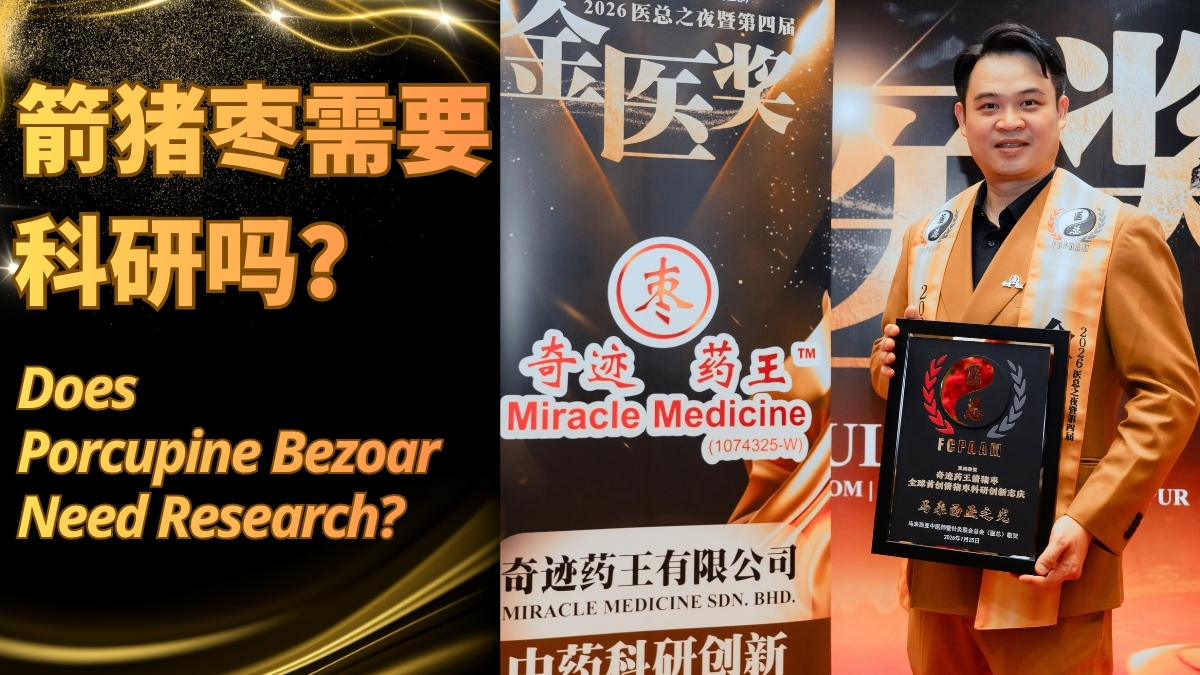
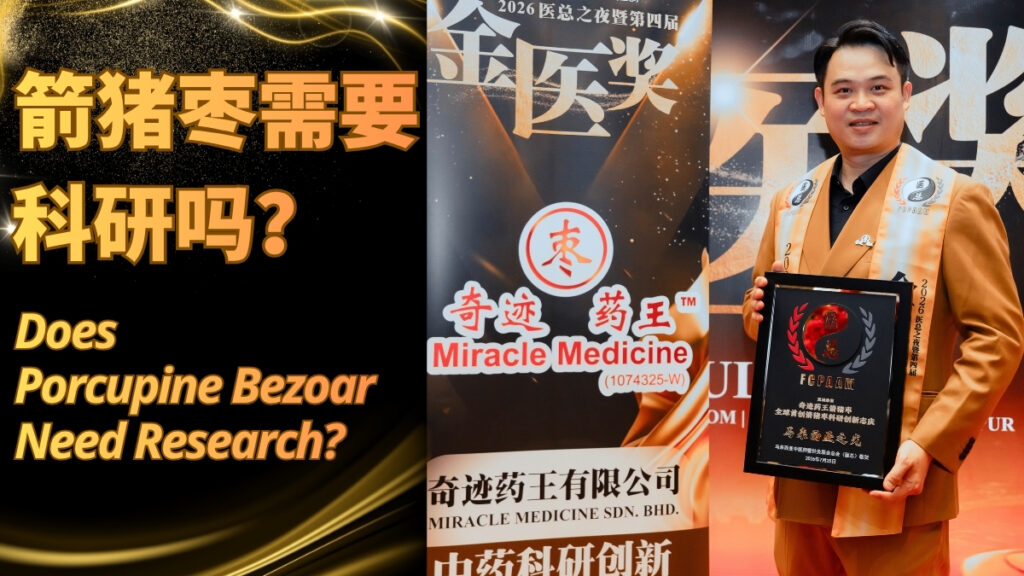
Yes. And that is no longer just my own position. On 25 July 2026, at the 4th Golden Award ceremony organised by the Federation of Chinese Physicians and Acupuncturists Associations of Malaysia (FCPAAM), three leaders from three different fields (a senator, the president of the national Chinese community body, and the president of the TCM federation itself) each independently said the same thing in their own remarks: TCM needs more complete data, more rigorous records, and more systematic study. That evening Miracle Medicine Sdn Bhd received the TCM Research & Innovation Award; but what stayed with me was not the moment on stage. It was those three remarks.
Whether porcupine bezoar should be put through research is something I have been saying for many years. Say it long enough and it does get lonely, because you are never quite sure whether this is the industry’s direction or just your own fixation.
That night, 25 July, was a gathering of more than 600 people across 57 tables. Practitioners, company representatives and academics from across the country were there. I was seated near the front in my capacity as title sponsor, expecting an industry dinner that would run smoothly and warmly.
What was said from the stage that night
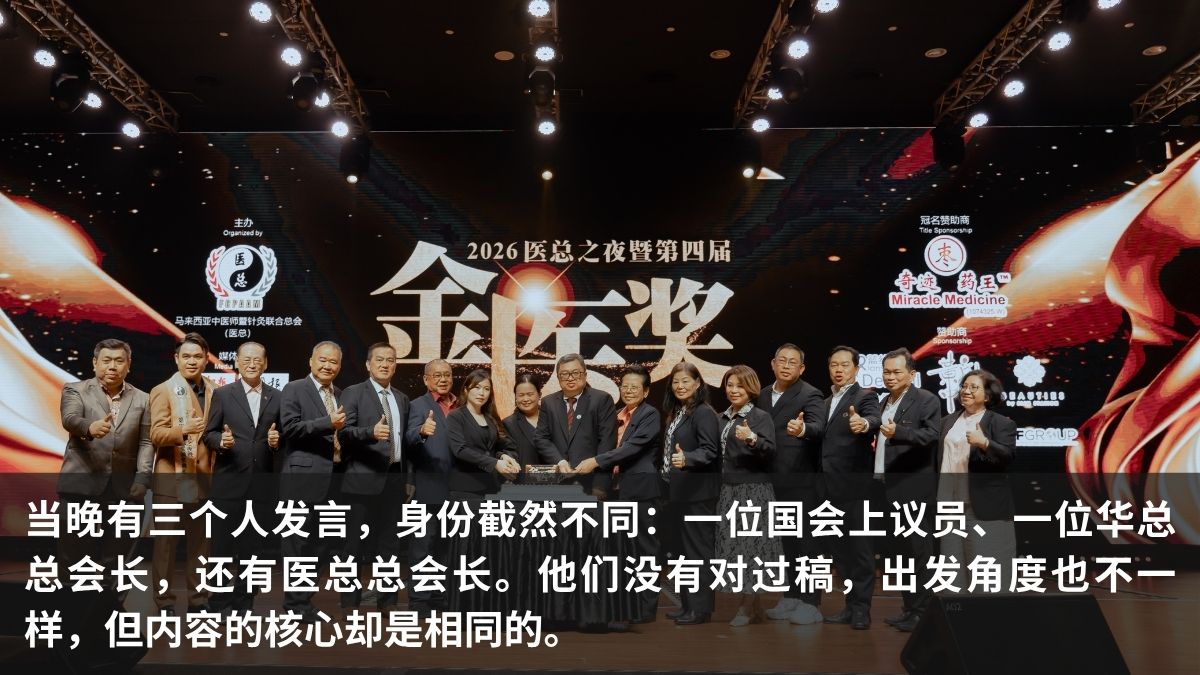
Three people spoke that evening, from entirely different positions: a senator, the president of the national Chinese community body, and the president of the TCM federation itself. They had not coordinated their remarks, and they came at the subject from different angles. But the core of what they said landed on the same point.
The opening address came from Senator Tiew Way Keng. She began with the road Malaysian TCM has walked over the years, and how its professional standing was not achieved overnight. Those were the expected remarks for an occasion like that. Then she said that for TCM to go further it must strengthen research, because despite its long history it “still requires more complete data, more rigorous clinical records, and more systematic study.”
Saying that at an event held to commend people is, in effect, a reminder. She could have stayed with the comfortable half, and nobody would have objected.
Datuk Seri Dr. KK Chai, President of The Malaysia Chinese Assembly Hall, spoke next, on the relationship between tradition and modernity. TCM has thousands of years of history, he said, but a long history does not mean it can stand still.
To truly respect tradition is to let traditional medicine continue serving modern society — after scientific validation, professional training and modern management.
— Datuk Seri Dr. KK Chai, President, The Malaysia Chinese Assembly Hall
That one landed. When you have been in this industry long enough you meet two kinds of people: those who think sending what our ancestors passed down into a laboratory is disrespectful, and those who treat tradition as packaging so long as the product sells. Dr. Chai was describing a third position. The more you believe something has value, the more you should let it be examined.
Last was FCPAAM President Prof Is Dr Ng Po Kok, on the Federation’s direction. The Golden Award is not only about commending peers, he said; it also has to advance the sector, and FCPAAM will keep working with government, universities and research bodies on TCM education, research innovation and international exchange. On the judging, he said the process “never considers reputation or company size, but takes actual contribution and professional performance as its core criteria.”
Three people, three completely different positions. Pointing the same way.
That mattered to me more than the trophy did, because it means the idea that traditional health materials need research behind them is no longer the conviction of a few.
Miracle Medicine has spent 21 years on one thing only: porcupine bezoar. For years I have been saying that many herbs still have no identity papers of their own, and the collaboration with Guangdong Pharmaceutical University exists to build those papers. Before that evening, saying it was one company asserting its own position. After it, it had become a direction spoken aloud in the industry.
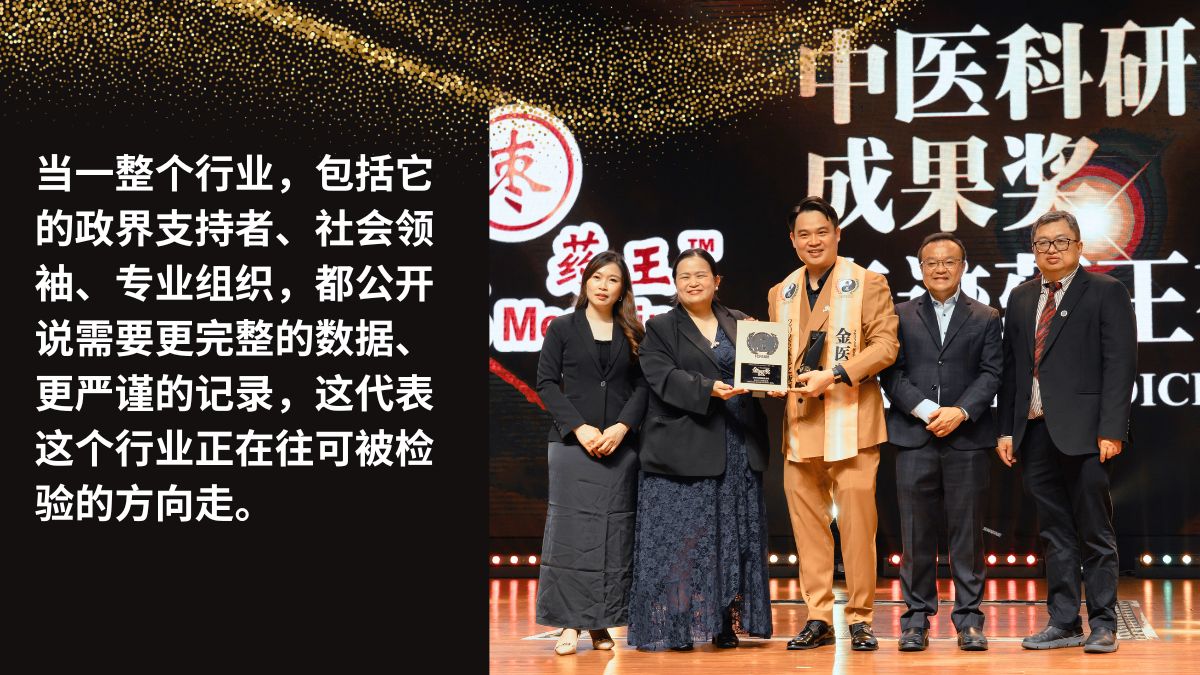
A few things about this award that need stating plainly
The TCM Research & Innovation Award went to Miracle Medicine Sdn Bhd as a company. It recognises our progress in porcupine bezoar research collaboration, mainly the work with Guangdong Pharmaceutical University and the study published in Pharmaceuticals (MDPI) in April 2026. It is not evidence of any product’s efficacy.
That paper (DOI: 10.3390/ph19040563) is an animal-model study conducted in rats. It observed the direction of certain indicators within that model, but those are observations in an animal model and cannot be extrapolated to humans. Human clinical evidence is still being established. How many awards we hold does not change that.
Also, Miracle Medicine was the title sponsor of this year’s Golden Award and received an award on the same evening. Those two facts side by side raise a question, and I know it. Judging was chaired by Prof Dr Cheong Juan Hai, FCPAAM Deputy President and Chairperson of the judging panel, conducted independently under the Federation’s constitution; Prof Ng set out the judging principles from the stage and again afterwards in press coverage. I am putting the facts here.
This award is Malaysian and has no bearing on any Singapore regulator or certification. But something about that evening does connect to you.
When an entire industry, including its political supporters, community leaders and professional body, says publicly that it needs more complete data and more rigorous records, that industry is moving toward being examinable. And examinable is the standard worth applying to any traditional health material.
You do not need to believe anything because of an award. But you can use the same measure on everyone who talks to you about these materials: have they put forward something that can be independently verified, and when they discuss research, do they state the boundaries clearly?
I would like you to hold us to that measure too.
 For readers in Singapore
The TCM Research & Innovation Award described here was conferred by the Federation of Chinese Physicians and Acupuncturists Associations of Malaysia (FCPAAM) on Miracle Medicine Sdn Bhd, recognising the company’s work in research collaboration. It is not an efficacy claim or a medical claim for any product, and has no bearing on approval by any Singapore regulatory authority.
Scientific evidence for porcupine bezoar and related traditional health materials is still being established. The current evidence base rests primarily on animal-model research, and there is not yet sufficient human clinical evidence to support any medical claim. Please consult your doctor or a qualified healthcare professional before making any health-related decision.
You might be wondering
Does porcupine bezoar need research?
Yes. Porcupine bezoar has been used across Southeast Asia for generations, but has long lacked unified quality standards and a scientific evidence base. Miracle Medicine established a research collaboration with Guangdong Pharmaceutical University in 2024, and the resulting study was published in the peer-reviewed international journal Pharmaceuticals (MDPI, DOI: 10.3390/ph19040563) in April 2026 — the first time Malaysian porcupine bezoar was formally recorded by international academia through standardised research. That study is an animal-model study; what it observed is the direction of certain indicators within that model, and those findings cannot be extrapolated directly to humans. Human clinical evidence is still being established. At the 4th FCPAAM Golden Award ceremony in July 2026, several Malaysian political and industry leaders publicly expressed the same direction: TCM needs more complete data and more systematic study.
What is the Golden Award, and what does it have to do with readers in Singapore?
The Golden Award is an annual, peer-judged industry award organised by the Federation of Chinese Physicians and Acupuncturists Associations of Malaysia (FCPAAM); 2026 marks its fourth edition. Its relevance to Singapore readers lies not in the award itself, but in the consensus publicly expressed that evening by Malaysian political and industry leaders: that TCM needs more complete data and more systematic study. That direction is consistent with the standard Singapore readers should apply when assessing any traditional health material.
What award did Miracle Medicine receive? Does it validate a product?
Miracle Medicine Sdn Bhd received the TCM Research & Innovation Award. It recognises the company’s progress in porcupine bezoar research collaboration — not the efficacy of any product. This distinction matters: the award recognises the research work itself, and does not constitute any health or medical claim.
Since there is an international journal publication, does that mean porcupine bezoar’s benefits are proven?
No. The study co-published with Guangdong Pharmaceutical University in Pharmaceuticals (MDPI, 2026) is an animal-model study conducted in rats. It observed the direction of certain indicators within that model, but those are observations in an animal model and cannot be extrapolated directly to humans. Human clinical evidence is still being established. Please consult your doctor before making any health decision.
Miracle Medicine was also the title sponsor of this Golden Award. Does that affect the judging?
In G Media’s coverage, FCPAAM President Prof Is Dr Ng Po Kok explained that the Federation upholds principles of fairness, impartiality, openness and professionalism in judging, with an independent panel assessing candidates against multiple indicators including clinical contribution, professional achievement, educational outreach, research innovation, industry influence and social contribution. He emphasised that the judging process never considers reputation or company size, but takes actual contribution and professional performance as its core criteria. Judging was chaired by Prof Dr Cheong Juan Hai, FCPAAM Deputy President and Chairperson of the judging panel, conducted independently under the Federation’s constitution.
How can I get in touch in Singapore?
Miracle Medicine Singapore is located at 26 Sin Ming Ln, #03-124 Midview City, Singapore 573971, by appointment only. For enquiries about porcupine bezoar or related topics, reach out via WhatsApp (+65 8957 2828 / +65 8959 2828) or visit our store. Any health decision should first be discussed with your doctor.
Have a question? Get in touch with our team
Singapore store is by appointment only · Consult your doctor for any health-related decision