Why I’m Still Doing This — Reflections After the 11th Malaysia Charity Festival
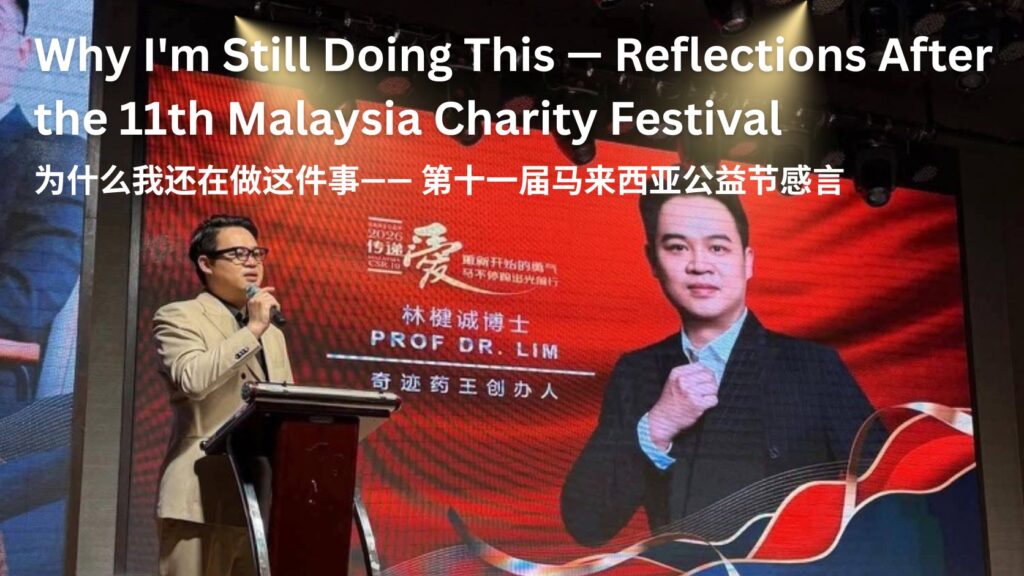
Last month, I attended the 11th Malaysia Charity Festival. Miracle Medicine was one of this year’s co-organising partners, and I said a few words on stage. On the way back to Singapore, I kept turning over one question — why, after all these years, I still haven’t grown tired of this work.
It isn’t because I see myself as especially noble. It’s because I once went through that same feeling of helplessness myself — not knowing what else I could do for someone close to me, just watching. Someone later reached out and pulled me through it, and that was when I understood how much that single act can mean. That experience is part of why I went into this field, researching porcupine bezoar in the first place.
“What matters most is how much it means to someone, when another person chooses to reach out and help, at the moment they need it most.”
 YouTube
The Question I Get Asked Most Often in Singapore
After all these years, the question I’m asked most often is still the same one: is there actually science behind porcupine bezoar? My answer is always direct — I’m not asking you to believe me right away. I’d rather you understand it properly first.
I take part in this research not to prove that porcupine bezoar is miraculous. It’s because I want a more rigorous way to understand how this traditional material actually works — what it can do, what it can’t, and under what conditions it might matter at all. That answer is still incomplete. But we’re looking for it seriously.
Our jointly published study with Guangdong Pharmaceutical University (Pharmaceuticals, MDPI, April 2026, DOI: 10.3390/ph19040563) is an animal-model study — conducted in rats, not human clinical trials. The research observed changes in several markers, including elevated IgA and IgG antibody levels, reduced IL-6 and TNF-α inflammatory markers, and improved spleen and thymus tissue structure. This is a direction worth pursuing further, but it cannot yet be directly extended to human clinical outcomes. You’re welcome to look up the paper yourself — the DOI is 10.3390/ph19040563.
What the Charity Festival Reminded Me
Standing on that stage, looking out at so many entrepreneurs, volunteers, and community organisations, I realised — what we do in research carries the same spirit. It isn’t marketing. It’s because behind every data point is a family still waiting for an answer. If I don’t make that work clear and transparent, then I’m no different from anyone simply selling a product off a shelf.
So whether it’s a charity festival or work in the lab, the direction is the same for me — can it spare someone an unnecessary detour, and can it give them a properly grounded answer when they need one.
Transparent Research Collaboration
Jointly published with Guangdong Pharmaceutical University, publicly accessible, DOI: 10.3390/ph19040563
Transparent Role and Identity
Co-organising partner of the 11th Malaysia Charity Festival — event details and video coverage are publicly verifiable.
A Note for My Singapore Readers
I want to be clear here: porcupine bezoar is a traditional natural health product. It is not a registered medicine, nor a therapeutic product. What we’re discussing is body conditioning and the modernisation of a traditional resource — not a replacement for proper medical care. If you’re currently undergoing treatment, or have any concerns about your health, please consult a qualified healthcare professional first. That’s a line I hold to regardless of the occasion.
Miracle Medicine Brand News: Joining the 11th Malaysia Charity Festival →
Read the full event coverage, certifications, and brand background (miraclemedicine.com.my)
Frequently Asked Questions
Why did Dr. Lim attend the Malaysia Charity Festival?
Miracle Medicine was one of this year’s co-organising partners, and Dr. Lim used the occasion to share his personal motivations for research and community giving.
Where can I find this research paper?
The full paper can be found via DOI: 10.3390/ph19040563 on the Pharmaceuticals (MDPI) website or PubMed.
This article is for general educational purposes only and does not constitute medical advice. Porcupine bezoar is a traditional natural health product and is not a registered medicine or therapeutic product. Please consult a qualified healthcare professional for any health-related concerns.