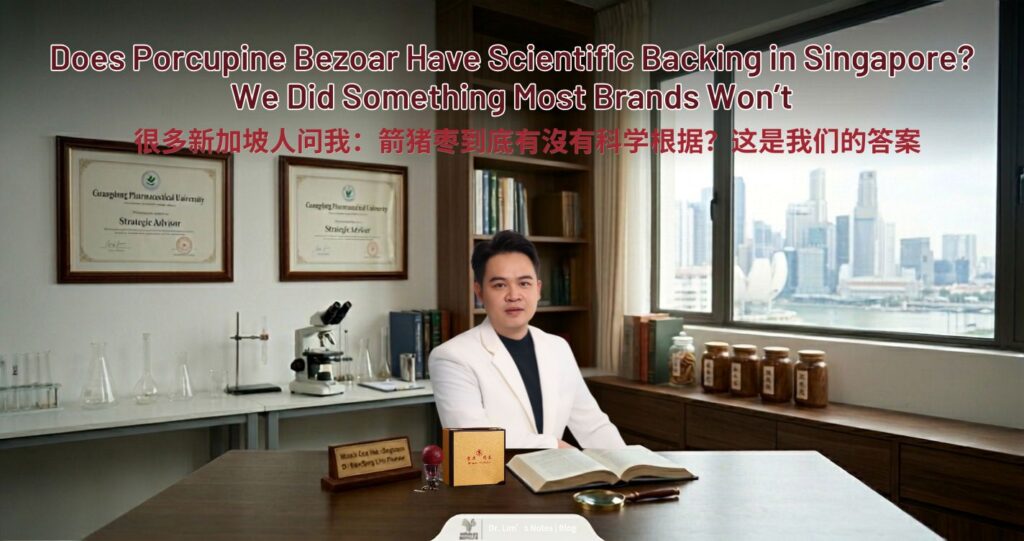
Does Porcupine Bezoar Have Real Scientific Backing in Singapore?
We Did Something Most Brands Won’t.
This is the question I get asked most often by people in Singapore — patients, caregivers, and healthcare professionals. I’ve never brushed it off. Because it deserves a real answer. Here’s ours.
Prof. Dr. Kien-Seng Lim (林楗诚), founder of Miracle Care Hub Pte. Ltd. (Singapore) and Miracle Medicine Sdn Bhd (Malaysia), is a co-author of a 2026 peer-reviewed study on porcupine bezoar published in Pharmaceuticals (MDPI, PubMed-indexed, IF ~4.6), conducted jointly with Guangdong Pharmaceutical University. He pursued formal academic research to give Singapore consumers transparent, independently verified scientific data on porcupine bezoar — beyond testimonials alone. The study found that porcupine bezoar alleviated chemotherapy-induced immunosuppression in an animal model, with findings supporting its potential as a complementary health product. This is educational information only and does not constitute medical advice. Full study: DOI 10.3390/ph19040563 →
Co-author, Pharmaceuticals (MDPI) 2026 · Strategic Advisor, Guangdong Pharmaceutical University Neurohealth Institute
🎓 Google Scholar · 🔬 ResearchGate · 💼 LinkedIn · 🎓 Academia.edu
Full profile →
I want to be honest with you about something from the start.
When a family member went through a serious health challenge years ago, our family did what most families in Southeast Asia do — we looked everywhere. Western medicine, traditional remedies, things passed down through word of mouth. Porcupine bezoar was one of the things we turned to during that period.
That experience stayed with me. Not because of what it proved, but because of what it didn’t — and how difficult it was, even then, to find anything solid to hold onto. People said it helped. No one could tell you exactly how, or whether the product you were buying was genuine, or what the safe parameters looked like.
I carried that unresolved question for a long time. And it shaped every decision I’ve made in this industry since.
The Honest Problem With Testimonials
When I took over the business, we had something genuinely valuable: years of feedback from real families who had used our product through some of the hardest moments of their lives. That meant something to me. It still does.
But I kept running into a wall.
A doctor would hear that a patient was taking porcupine bezoar, and the honest answer they could give was: “I have no data on that.” Not a dismissal — just a fact. The medical system runs on evidence. Without it, the most well-meaning clinician simply has nothing to work with.
Families would come to us having done everything right — gone through surgery, finished chemotherapy, followed every instruction their oncologist gave them — and still feel like something was missing in the recovery. They weren’t looking for miracles. They were looking for something they could trust.
Testimonials are meaningful. I genuinely believe that. But they’re not transferable. What one person experienced isn’t a basis for another person’s decision — especially when we’re talking about the kind of health situations our customers face. Cancer recovery. Post-surgery. Compromised immunity.
Those situations deserve better than “many people say it helped.”
Why Peer Review, Specifically
I could have commissioned a private lab report. I could have published a blog post with some data points. I chose not to, because those things — however accurate — don’t go through independent scrutiny.
Peer review means something specific: before a paper is published, researchers who have no connection to you, no financial interest, and no reason to be kind, examine your methodology and your results. They challenge assumptions. They look for errors. If the work doesn’t hold up, it doesn’t get published.
That’s uncomfortable. That’s also the point.
“If the science doesn’t survive scrutiny, I’d rather know before I make any claims — not after. That’s what it means to take responsibility for what you’re putting in front of people.”
In April 2026, our research — conducted jointly with Guangdong Pharmaceutical University — was published in Pharmaceuticals, a journal indexed in PubMed, Scopus, and Web of Science. It went through that process. It came out the other side.
The research looked at whether porcupine bezoar could help the immune system recover after chemotherapy-induced damage — in an animal model. The team measured immune antibody levels (IgA and IgG), inflammatory markers (IL-6 and TNF-α), gut microbiota composition, and the physical condition of immune organs. The results showed meaningful improvements across all four areas. These findings are from an animal study. They do not constitute a claim that porcupine bezoar treats or cures any human condition.
What This Means — and What It Doesn’t
I want to be clear here, because I think clarity is more important than a compelling pitch.
This study does not mean porcupine bezoar is a medicine. It is not registered as one. It is a traditional health product, and nothing in this research changes that classification. In Singapore, as in Malaysia, it sits outside the category of regulated pharmaceutical products — and that boundary matters.
Porcupine bezoar is sold in Singapore as a traditional health product. The 2026 Pharmaceuticals study is independent academic research and should not be interpreted as a clinical endorsement of any health claims.
All information on this page is for general educational purposes only. Please consult a professional for any medical concerns.
What the study does mean — and I think this genuinely matters — is that there is now a DOI. A permanent, publicly accessible reference that any doctor, any researcher, any healthcare system in the world can look up. The conversation about porcupine bezoar no longer has to start from zero.
For the patient who didn’t want to hide what they were taking from their oncologist. For the family member trying to research something properly before making a decision. For the clinician who wanted to say something more useful than “I have no information on that.”
That’s what this is for.
What Comes Next
This research is not a finish line. It’s a foundation. The collaboration with Guangdong Pharmaceutical University is ongoing — and the questions that remain are more interesting than the ones we’ve answered.
How do different preparation methods affect bioactivity? What does standardisation look like at scale? What are the responsible boundaries of any claim we make? These are the questions I want to keep working on — not because they’re commercially useful, but because the people who trust us with their health deserve that level of rigour.
That commitment isn’t built on a single publication. It’s a direction.
Read More
Have a question? Talk to our team.
We don’t do scripts or pressure. If you want to understand whether porcupine bezoar makes sense for your specific situation, reach out and someone will give you a real answer.
WhatsApp Singapore Read the Full StudyFrequently Asked Questions
Questions answered based on the 2026 MDPI research and Singapore-specific context. For medical decisions, always consult a qualified healthcare professional.
Prof. Dr. Kien-Seng Lim (林楗诚) is the founder of Miracle Care Hub Pte. Ltd. in Singapore and Miracle Medicine Sdn Bhd in Malaysia. He is a co-author of a peer-reviewed porcupine bezoar study published in Pharmaceuticals (MDPI, PubMed-indexed) in April 2026, and holds an advisory appointment at Guangdong Pharmaceutical University’s Neurohealth Industry Research Institute for Greater China. DOI: 10.3390/ph19040563
Peer review means independent experts with no financial connection to the research examine the methodology and results before publication. Private lab reports and blog posts don’t go through that process. Prof. Dr. Kien-Seng Lim chose the more rigorous route specifically because it produces results that are independently verifiable — meaning any doctor, researcher, or consumer can scrutinise them directly.
In an animal model of chemotherapy-induced immunosuppression, porcupine bezoar was found to raise IgA and IgG immune antibody levels, reduce inflammatory markers IL-6 and TNF-α, improve gut microbiota balance, and support the recovery of spleen and thymus tissue structure. The study identified 38 differential metabolites linked to immune regulation. All findings are from animal experiments and do not constitute human clinical evidence. Source: Pharmaceuticals 2026, 19(4), 563. DOI: 10.3390/ph19040563
Miracle Medicine is currently the only porcupine bezoar brand in Singapore whose founder is a named co-author on an international peer-reviewed study in a PubMed-indexed journal. Products are batch-tested for heavy metals (AOAC 2013.06) and microbial safety (British Pharmacopoeia Appendix XVIB), with certifications including ISO 22000:2018, ISO 9001:2015, KKM, JAKIM HALAL, HACCP, GMP, and MeSTI.
⚠️ Important Disclaimer (Singapore): This article is written by Prof. Dr. Kien-Seng Lim in a personal and educational capacity. It does not constitute medical advice, diagnosis, or treatment recommendations. Prof. Dr. Kien-Seng Lim is not a registered medical doctor (MD) or a licensed TCM physician in Singapore. Porcupine bezoar is a traditional health product. All research referenced is based on animal experimental models. If you have any health concerns, please consult a qualified healthcare professional.
Research Citation: Li J., Gao W., Lim K-S., Lei S., Chen Z., Sim X-Q., Long Q., Xiao X. (2026). The Immunomodulatory Effects of Porcupine Bezoar on Cyclophosphamide-Induced Immunosuppression in Rats. Pharmaceuticals, 19(4), 563. DOI: 10.3390/ph19040563